Barack Obama signs Freedom of Press Act on May 17, 2010 which attempts to provide more protections to members of the press across the world by identifying countries where freedom of press is being violated. Also called the Daniel Pearl Act, as it has the support from the widow of Daniel Pearl, the American journalist murdered by Islamic terrorists in 2001. Obama has had strong legislative battles with Congress, but has also had tremendous success, notably the passage of health care last year.
Monday, February 7, 2011

President Obama and Prime Minister Cameron: Diplomacy at Work
A joint press conference between Barack Obama and newly elected British Prime Minister David Cameron last year. Obama seems to be effective in dealing with foreign leaders, especially Cameron, who seems(beside ideological differences) seems to have some similarities to.
Note: the video is 32 minutes long so don't be expected to watch the whole thing. It may also take a while to load.
Note: the video is 32 minutes long so don't be expected to watch the whole thing. It may also take a while to load.
George H W Bush Announces War Against Iraq
On January 16, 1991 George H. W. Bush spoke to the nation, announcing the beginning air strikes against Iraq and the deployment of US and coalition troops to drive Saddam Hussein out of Kuwait. The war was a tremendous success, with US forces driving Iraqi troops out of Kuwait within a week and ultimately bolstering US pride which had been greatly scarred by Vietnam.
Heck of a job Brownie: Bush as a Crisis manager
A rather infamous moment that seemed to reflect the management of Hurricane Katrina by the Bush Administration. Bush was greatly criticized for mismanaging the government reaction to the crisis, partly because of factors that may have been beyond his control.
National Mourner: Reagan on the Challenger Disaster
This is Ronald Reagan addressing the nation on January 28, 1986 after the space shuttle Challenger exploded soon after takeoff, killing all the astronauts. This is one of most memorable speeches that Reagan ever gave, as he was able to briefly and simply comfort a shocked nation in the aftermath of the tragedy.
Monday, January 31, 2011
Johnson Vs. Radical Republicans: The Road to the First Impeachment
 |
| Illustration of Andrew Johnson receiving notice of his Impeachment. |
When Andrew Johnson, president of the United States, was impeached by the House of Representatives on February 24, 1868, it was the near climax of the political battle that had been raging between Johnson and Republicans in Congress ever since Johnson had assumed office. Johnson had been a Senate Democrat from Tennessee, the only Southern Senator to stay with the Union, when he was selected to be Vice-President on President Lincoln's reelection ticket in 1864. Ascending to the presidency after Lincoln's assassination, Johnson faced the daunting task of uniting a nation that had been deeply divided after four years of war. The key issues in postwar Reconstruction were how to readmit the former Confederate states and how newly freed slaves would be given rights.
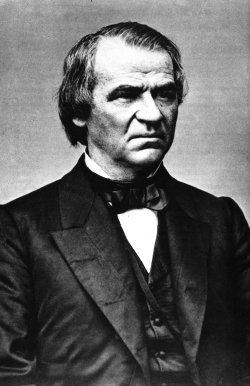 |
| Andrew Johnson |
Only after a month in office, Johnson began to issue pardons to ex-Confederates, with the exception of former political, military leaders and wealthy plantation owners, allowed former rebels to reclaim confiscated property. Johnson also allowed the southern states to draft state constitutions which abided by the thirteenth amendment. These new southern governments then quickly began to implement "black codes" laws which largely deprived newly freed slaves of their rights. When Republicans in Congress resumed session in December, they expressed outrage over this turn of events.
 |
| Republican Senator Thaddeus Stevens |
Led by the so called "Radicals", Congressional Republicans sought to pass legislation in opposition to the president's Reconstruction policies. Republicans passed a bill in 1866 which would expand the power of the Freedmen's Bureau, only to have it vetoed by Johnson. That same year, Congress passed the Civil Rights Bill of 1866, which would declare ex-slaves to be citizens. This time, Republicans managed to override Johnson's veto, the first time in American political history. From that point, Republicans began to introduce their own Reconstruction strategy, that would divide the South into military districts and would strictly enforce rights for freed slaves.
In 1867, over Johnson's veto, Republicans passed the Tenure of Office Act. This act, considered today to be unconstitutional, required the approval of the Senate when dismissing cabinet members. Johnson, in open and deliberate defiance of the act, fired Secretary of War Edwin Stanton, who supported the Radical Republicans. Declaring Johnson to be in constitutional violation, House Republicans soon began impeachment proceedings against the president.
Sources include:
http://www.crf-usa.org/impeachment/impeachment-of-andrew-johnson.html
http://www.law.umkc.edu/faculty/projects/ftrials/impeach/imp_account2.html
http://www.law.umkc.edu/faculty/projects/ftrials/impeach/imp_tenure.html
Tuesday, January 4, 2011
Afghanistan Development (GAO Document)
The formal title of this document is "Afghanistan Development: U.S. Efforts to Support Afghan Water Sector Increasing, But Improvements Needed in Planning and Coordination". The report was completed on November 15, 2010. The full report is about 75 pages long.
The document begins by describing water as a substance "critical to the stability of Afghanistan" and as an "essential part" of the reconstruction of Afghanistan. Since 2002, the second year of the war in Afghanistan, the United States Agency for International Development (USAID) and the Department of Defense gave given out $250 million for the funding of water projects in Afghanistan. The goal of supporting Afghanistan's fledgling water sector is both shared and supported by the US and and the Afghan government. Strategies' to improve Afghanistan's water system have included improving access to safe drinking water, improved irrigation, and development in the water sector. The 2010 Inter-Agency Water Strategy by the US government identifies short, medium, and long-term goals that the US wishes to see completed between 2010 and 2014. The US government apparently expects to increase water sector development between 2010 and 2014 and estimates that to fund such projects will require about $2.1 billion.
Another important feature in the report is the emphasis on greater inter-agency cooperation. This emphasis comes from the Government Performance and Results Act and several other strategic documents relating to the US mission in Afghanistan. The GAO reports that it has included such importance of inter-agency cooperation in other strategic reports, especially when those agencies are involved in counter-terrorism activities.
Sources include the link to the original document off the Government Accountability Office Website
http://www.gao.gov/products/GAO-11-138
Subscribe to:
Posts (Atom)